
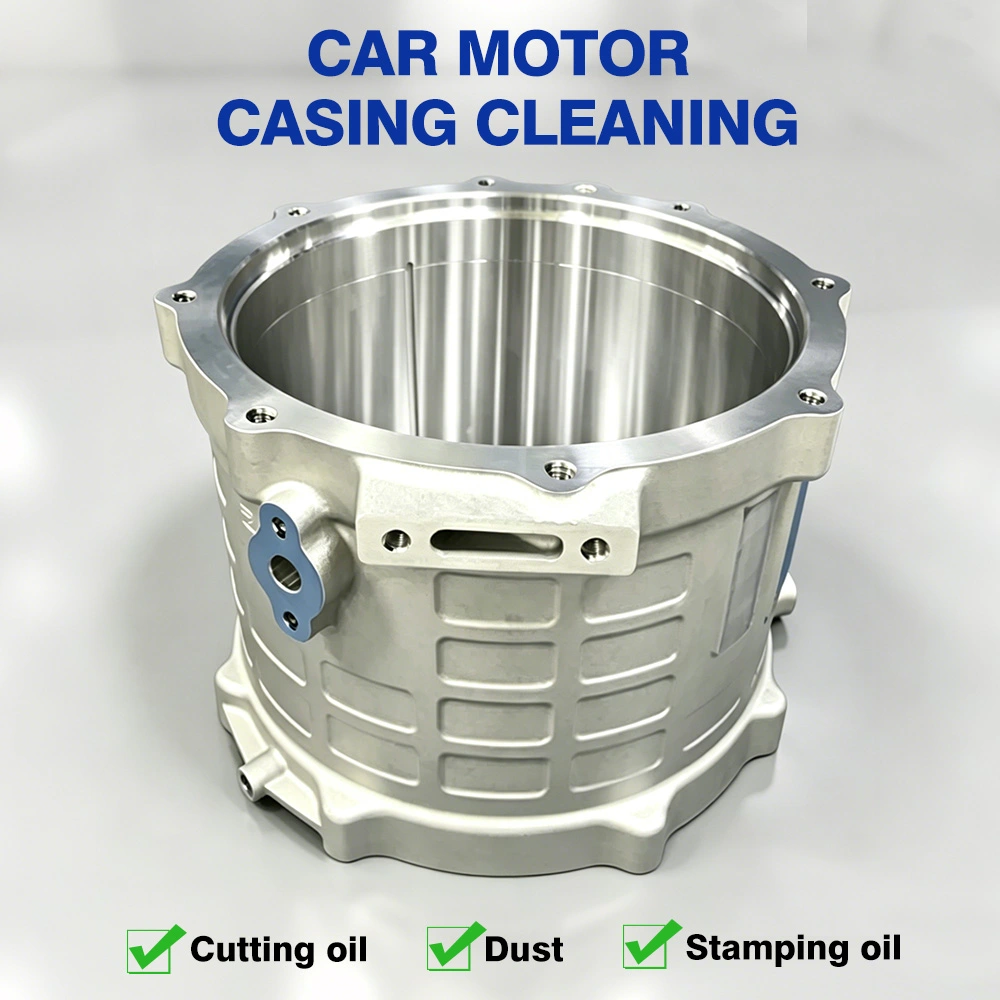
RSB-108 Car motor housing cleaner Aluminum degreaser
Fully customizable OEM solutions for RSB-108. Our aluminum safe degreaser offers industry-leading performance as a professional aluminum cleaner solution.
View productRSB-108 is a water-based aluminum degreaser built with patented surfactants and aluminum corrosion inhibitors, and the published test data behind it makes the product a defensible aluminum cleaner solution for die-cast housings, sheet, foil and galvanized parts. Use this hub to match your alloy, your soil and your cleaning method to the right grade before you commit a production bath.

Start from the substrate and the soil you are actually fighting, then confirm the method your line already runs. Each row returns the recommended cleaning path and the control value that keeps it stable.
| Substrate + soil | Recommended path | Method fit | Line-control note |
|---|---|---|---|
| Die-cast aluminum motor and engine housings with cutting oil | RSB-108 (default aluminum path) | Hot soaking or ultrasonic, suited to complex geometries | Run a 5–10% solution at 55–65 °C and verify the rinse stage leaves no visible residue |
| Aluminum sheet and foil with stamping oil | RSB-108 | Spray cleaning or manual scrubbing | Foam stays at ≤20 mm after 5 minutes at 50±2 °C, which keeps spray cabinets and nozzle banks stable |
| Lithium battery shells with oil and fingerprints | RSB-108 | Spray cleaning plus manual scrubbing | pH-controlled alkaline formula; check refraction against 23.0–25.0 to hold bath strength |
| Galvanized parts with dust and shop soil | RSB-108 | Soak tank or ultrasonic tank | Heavy-metal-free formula supports environmental compliance paperwork on the line |
| Mixed line running aluminum alongside copper or stainless stages | RSB-108 for the aluminum stage, then review adjacent grades | Sequence the stages rather than sharing one bath | Compare the adjacent grades below and coupon-test before merging rinse stages |
If aluminum is the dominant substrate, RSB-108 is the default answer — it covers cutting oil, stamping oil, dust and fingerprints on common aluminum and its alloys, aluminum foil, aluminum plates and galvanized parts. If aluminum is a minority substrate on a mixed line, treat this table as a starting point and compare the adjacent grades in the multi-metal section before you lock the chemistry.
RSB-108 is a water-based cleaner built on patented surfactants plus aluminum corrosion inhibitors, and it is free of heavy metals. Its working solution is genuinely alkaline: pH 11.0–12.0 measured on a 5% solution at 25 °C. A high pH reading by itself tells you almost nothing about whether a chemistry will attack aluminum — the inhibitor package and the alloy grade decide the outcome.
On the published corrosion test, LY12 hard aluminum is reported at Grade 0, meaning no visible corrosion under the test conditions. That is a specific result on a specific alloy, and it is the right way to read it.
Alkaline cleaners can dull or darken some aluminum surfaces as a side effect of cleaning, especially with long dwell times or elevated temperature. Grade 0 is not a blanket approval for every alloy, every cycle count and every temperature. Run a coupon test on the exact alloy you produce, and keep the bath inside the recommended concentration and temperature window.

Four cleaning methods are supported. The one number that governs which tanks you can run is the foam ceiling, because foaming is what breaks spray cabinets and ultrasonic cavitation.
Supported. Cleaning force is published at ≥95% at 60 °C, which is why the 55–65 °C band is the recommended operating window.
Explicitly listed as suitable for ultrasonic use, and designed for seamless integration with existing ultrasonic systems without risk of equipment corrosion.
Supported and compatible with existing spray systems. The ≤20 mm foam ceiling after five minutes is what keeps nozzles, risers and collection tanks from surging.
Supported, and the practical option at room temperature. The product performs consistently at ambient, with better results once the bath is brought up to temperature.
A spray line and an ultrasonic tank make very different demands. If your process is spray-based or runs a high-energy ultrasonic transducer stack, the low foam profile is the reason to standardize on this chemistry rather than a high-foaming alkaline. If your process is a soak tank with manual touch-up, temperature control matters more than foam — and that decision drives your heating budget, not your chemical spend.

Removes cutting oils and stamping residues, and is compatible with hot soaking and ultrasonic cleaning for complex geometries. The heavy-metal-free formulation supports environmental regulatory compliance on the plant floor.
Buyer decision: if your housings have blind pockets and internal oil galleries, choose the soak or ultrasonic route and budget the 55–65 °C heating rather than a longer dwell at room temperature.
Cleans battery shells without inducing corrosion, using a pH-controlled alkaline formula that removes oils and fingerprints. Compatible with spray cleaning and manual scrubbing.
Buyer decision: where surface appearance and residue carry risk downstream, prioritize the no-visible-residue rinse claim and confirm it on your own shell alloy before scaling.
The published index values are only useful once they become operator actions. This table converts each parameter into the decision it should trigger on the tank.
| Spec | What it means | Control action |
|---|---|---|
| Appearance: colorless transparent liquid | A visual baseline for a fresh drum and for a clean bath. | Check appearance at each top-up; discoloration signals dragged-in oil load and points to a bath change. |
| Specific gravity: 1.09 ± 0.02 | A physical fingerprint of the concentrate and its dilution. | Use it as a fast strength check when you have no refractometer on hand. |
| Cleaning force (60 °C): ≥95% | Performance is referenced at temperature, not at ambient. | Set the bath to 55–65 °C before judging results; do not extend dwell time as a substitute for heat. |
| pH value (5% solution, 25 °C): 11.0–12.0 | An alkaline working range that is deliberately buffered. | Measure pH after every major top-up and after drag-out events; recalibrate the meter on schedule. |
| Corrosive: LY12 hard aluminum — Grade 0 | No visible corrosion on that reference alloy under test conditions. | Reproduce the coupon test on your own alloy and cycle count before releasing the bath to production. |
| Rinsing performance: no visible residue | The rinse stage, not the wash stage, decides whether you need extra post-processing. | Inspect a dried coupon under light after rinsing; if a film appears, review rinse water quality and drag-out. |
| High-temperature stability: uniform, no stratification at (60±2) °C for 6 h | The bath holds together through a full hot shift. | Safe to run through a long hot soak cycle without expecting separation. |
| Low-temperature stability: uniform, no stratification at (−5±2) °C for 24 h | The concentrate survives cold storage and shipping conditions. | Winter storage in unheated warehouses does not require special handling — but bring the drum to room temperature before make-up. |
| Foam property (50±2 °C): ≤20 mm in 5 min | A low-foam profile at working temperature. | The gate that makes spray and ultrasonic processing viable; re-check if you change nozzle layout or air agitation. |
| Refraction rate: 23.0–25.0 | The fast, repeatable way to track real bath concentration. | Refractometer reading inside 23.0–25.0 means the bath is on target; outside it, adjust make-up concentration. |
A chemistry decision made in a meeting should be confirmed on a coupon before it reaches the tank. This sequence uses only values the product page already publishes, so your trial has a defined pass/fail instead of an opinion.

Selection questions convert fastest when the technical detail is complete. Send these six inputs with your enquiry and the response can be a specification recommendation rather than a price list.

Keep adjacent product options together for a faster catalog comparison.
Fully customizable OEM solutions for RSB-108. Our aluminum safe degreaser offers industry-leading performance as a professional aluminum cleaner solution.
View product
Ensure optimal surface integrity with our professional industrial metal cleaner. This high-performance parts cleaner delivers residue-free results for alloys.
View product
Source RSB-103C industrial metal degreaser for efficient, low-foam cleaning. Our formula ensures rust-inhibited surfaces as a trusted bulk degreaser provider.
View productit removes cutting oil, stamping oil, dust and fingerprints from aluminium, aluminium alloy, aluminium foil, aluminium sheets and galvanized parts. the applicable-materials list is common aluminium and its alloys, aluminium foil, aluminium plates and galvanized parts.
the published value is ph 11.0–12.0 measured on a 5% solution at 25 °c, and the recommended working concentration is a 5–10% aqueous solution of the cleaning agent. because it is alkaline, confirm results on your own alloy before a full production release.
room temperature is usable and performance is consistent there, but the better effect is at 55–65 °c. cleaning force is published as ≥95% at 60 °c, so temperature is the lever you should reach for first.
yes. it is listed as suitable for ultrasonic use and compatible with spray cleaning, hot soaking and manual scrubbing, and the page states it integrates with existing ultrasonic and spray cleaning systems without risk of equipment corrosion. the foam property of ≤20 mm after 5 minutes at 50±2 °c is the supporting figure for that compatibility.
the published corrosion test reports ly12 hard aluminium at grade 0, and the formula uses aluminium corrosion inhibitors and is free of heavy metals. that result applies to that tested alloy and conditions — it is not a universal guarantee, so coupon-test your specific alloy, dwell time and temperature. alkaline cleaners can also darken some aluminium surfaces, which is another reason to validate first.
packaging is 25 kg per barrel and 200 kg per barrel, generally in neutral white boxes and brown cartons, with branded packaging available against an authorization letter for a legally registered patent. samples are available if in stock, with the customer covering sample cost and courier fee, and custom production from customer samples is supported. payment terms are 30% t/t deposit with 70% before delivery, fob, with a normal lead time of 15 to 45 days after advance payment.
